

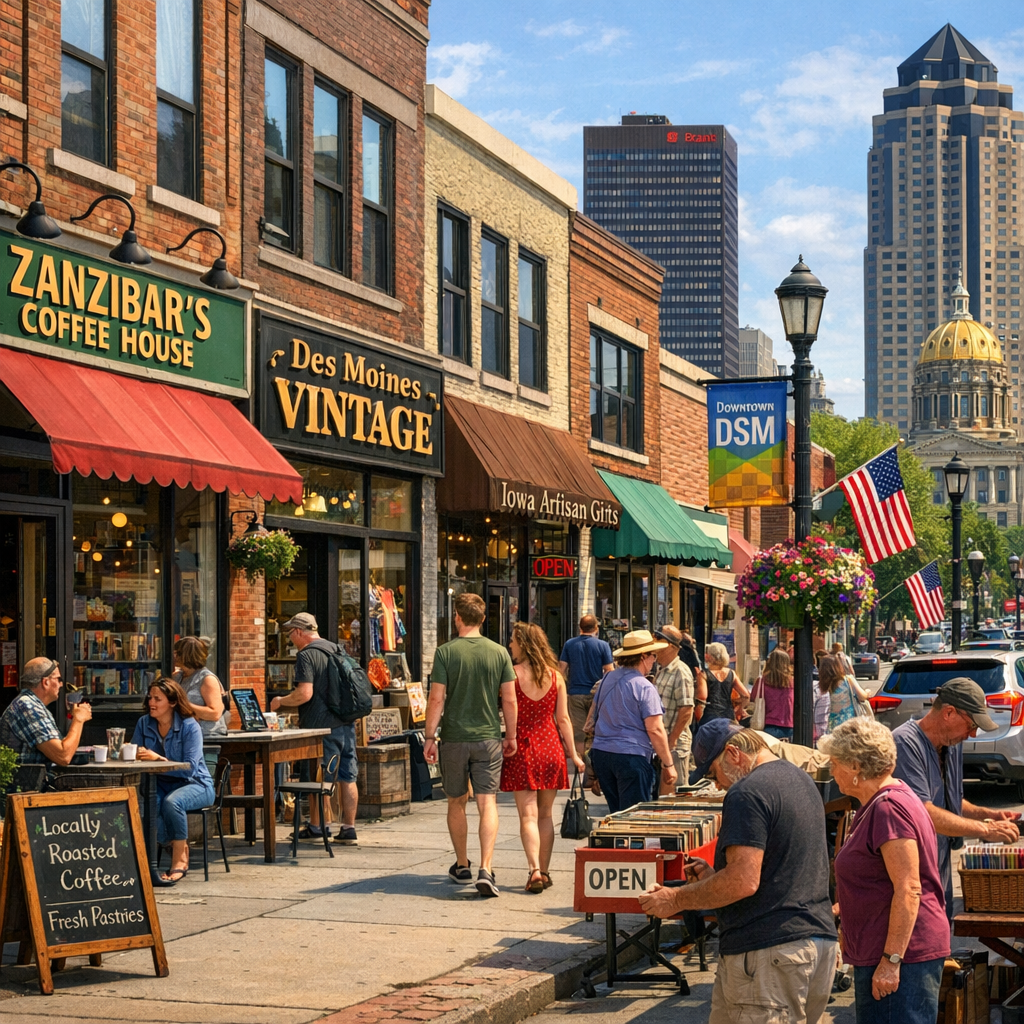
Des Moines’ business environment continues its evolution—not with dramatic headlines, but through steady trends that are reshaping opportunities for entrepreneurs, employees, and neighborhoods. Below are key patterns shaping the local economy and ideas business owners are using to stay ahead.
1. Demand and office/retail space tightness
Metro Des Moines is seeing strong demand for office and retail space even as supply remains constrained. Retail vacancy rates have dipped to around 3.5%, the lowest in over a decade, while retail and office tenants are either renewing, expanding, or relocating into existing space downtown. Suburban Class A margins are under pressure, especially where new supply is scarce.
For business owners, that means costs of space are rising, and ideal locations may be harder to secure. Downtown space is especially desirable for visibility and foot traffic, but smaller operations may have to look toward creative leases or shared spaces in neighborhoods.
2. Hybrid and remote work reshape local economic rhythms
The shift in how people work—balancing office, hybrid, and remote setups—continues to impact downtown corridors, commuter patterns, and neighborhood hubs. Reduced daytime density downtown affects nearby restaurants, shops, and service businesses; in some suburbs, access to transit and job hubs has become more uneven.
Some businesses are responding by rethinking location strategy (e.g. flexible leases outside central business districts), adjusting hours to match changing foot traffic, and investing in digital tools to reach customers who are no longer passing by storefronts daily.
3. Niche, local, and sustainable offerings stand out
Shoppers across the Des Moines metro are favoring businesses that offer local, sustainable, handcrafted, or personalized products. Trends in refill shops, vintage goods, artisan bakeries, and local food markets reflect customers’ growing interest in authenticity and values-driven purchases.
For entrepreneurs, succeeding in these niches often means mastering the business side—managing overhead, building an online presence, and communicating clearly what makes their products different. Many find success in markets, pop-ups, or operating in business incubators until a full-scale permanent location is sustainable.
4. Incentives, grants, and creative financing
City and nonprofit programs are playing a bigger role in supporting small businesses. For example, Des Moines has launched “Restore the Core DSM”, which offers matching reimbursement grants (up to $200,000) to help rehabilitate vacant ground-floor commercial spaces for public-facing uses. Meanwhile, organizations focused on neighborhood impact have helped revitalize historic business districts.
Entrepreneurs should be tracking available incentives, exploring partnerships with local groups, and keeping detailed business plans ready. Those prepared to match grant timelines or leverage zoning tools often gain advantage.
5. Practical adoption of technology
Rather than chasing flashy tech trends, many Des Moines small businesses are seeing value in applying AI and automation to repetitive tasks—customer‐service chatbots, lead generation, inventory forecasting, and content generation. When those tools are used thoughtfully, they free up owner time and often yield measurable efficiency gains.
Still, businesses find that good data, thoughtful implementation, and preserving human-centered service are essential. Missteps like over-automation or poor user experience can erode trust even faster than digital inaction becomes obvious.
What local business owners can do
- Identify one process to improve or automate this quarter (e.g. responding to common customer questions; social-media scheduling).
- Explore shared or nontraditional space options—neighborhood storefronts, pop-ups, or co-working—that reduce cost and risk.
- Stay connected with local business networks, chambers, and programs offering grants or advisory services.
- Tailor offerings to the preferences gaining traction: sustainability, craftsmanship, local identity.
- Monitor commuting and foot traffic shifts; align your hours, services, and location strategy with where customers are—physically or digitally.
In Des Moines’ changing economic landscape, the businesses that adapt quietly often wind up leading bigger changes. With thoughtful strategy, connection, and willingness to experiment, there’s room for both newcomers and established players to grow.